
Universal Truths Abide in Medicine, Even in Parallel Universes
Medicine is practiced differently around the world, and yet some aspects — especially the frustrations — are fairly universal. Where better can you experience the similarities and differences than in the blogging world, where clinicians share stories from their practices and their personal lives? Two physician bloggers, known as “Dr. Dino” and “Dr. Emer,” provide […]
Did Low Payments in Ambulatory Care Spawn the Hospitalist Movement?
One of the most interesting developments in American healthcare in the past decade is the emergence of hospitalists: internists whose sole job is to manage hospitalized patients, and who never venture into the more traditional outpatient setting.One hospitalist, who goes by the pen name Happy Hospitalist on his eponymous Web site, believes that his specialty […]
Critically Ill Patients Seen More Likely to Die With Treatment by Intensivists
Surprisingly, and contrary to previous findings, new research indicates that critically ill patients who are managed by a critical care physician are more likely to die than those managed by other doctors. While some of this difference reflects the fact that patients treated by critical care physicians are generally sicker, even after adjusting for this, […]
VA Study: ART Confers Negligible Risk for Heart Disease
Four-year follow-up of more than 40,000 HIV-infected patients revealed no association between longer durations of ART exposure and risk for cardiovascular disease. Summary Many antiretroviral regimens have been associated with metabolic perturbations that are linked to risk for atherosclerotic heart disease. Consequently, there is keen interest in determining the rates of cardiovascular events among HIV-infected […]
Post-Myocardial Infarction Cardiogenic Shock: What’s New?
Cardiogenic Shock: Current Concepts and Improving OutcomesReynolds HR, Hochman JSCirculation. 2008;117:686-697 Cardiogenic Shock: Basics and Clinical ConsiderationsGowda RM, Fox JT, Khan IA Int J Cardiol. 2008;123:221-228 Historically, cardiogenic shock (CS) was nearly always fatal after myocardial infarction (MI). Mortality rates were consistently reported at approximately 80% until the 1990s, when the mortality improved but only […]
Black-Spot Poison Ivy
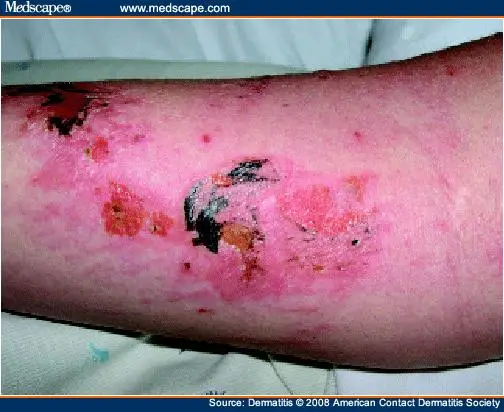
Abstract In black-spot poison ivy dermatitis, a black lacquerlike substance forms on the skin when poison ivy resin is exposed to air. Although the Toxicodendron group of plants is estimated to be the most common cause of allergic contact dermatitis in the United States, black-spot poison ivy dermatitis is relatively rare. Case Description A 34-year-old […]
Blood Glucose Variability Predicts ICU Deaths
Wide fluctuation in blood glucose levels in critically ill patients is a predictor of mortality in those patients, suggests a study presented here at the American Thoracic Society 2008 International Conference. Hasan Al-Dorzi, MD, a pulmonary critical care consultant at King AbdulAziz Medical City/King Fahad National Guard Hospital in Riyadh, Saudi Arabia, said he and […]
Acute Poststroke Seizures Linked to Higher 30-Day Mortality
Acute seizures are associated with a higher mortality at 30 days after stroke, according to the results of a population-based study reported online in the January 31 issue of Epilepsia and will appear in the June 2008 print issue. “Cerebrovascular disease has long been recognized as a risk factor for the development of epilepsy and […]
New Recommendations Issued for Treatment of Malaria in the United States
A systemic review of treatment of malaria in the United States, published in the May 23/30 issue of JAMA, provides recommendations to minimize morbidity and mortality of this disease. “Even though endemic malaria has been eliminated from the United States, it remains a leading infectious disease worldwide,” write Kevin S. Griffith, MD, MPH, from the […]
Fluticasone Spray for Allergic Rhinitis May Not Suppress Hypothalamic-Pituitary-Adrenal Function
Fluticasone furoate nasal spray did not suppress the function of the hypothalamic-pituitary-adrenal [HPA] axis in teens and adults with allergic rhinitis (AR), according to the results of a short-term, double-blind, randomized study reported in the May issue of Annals of Allergy & Asthma Immunology. “Intranasal corticosteroids are recommended as first-line therapy for [AR], and because […]